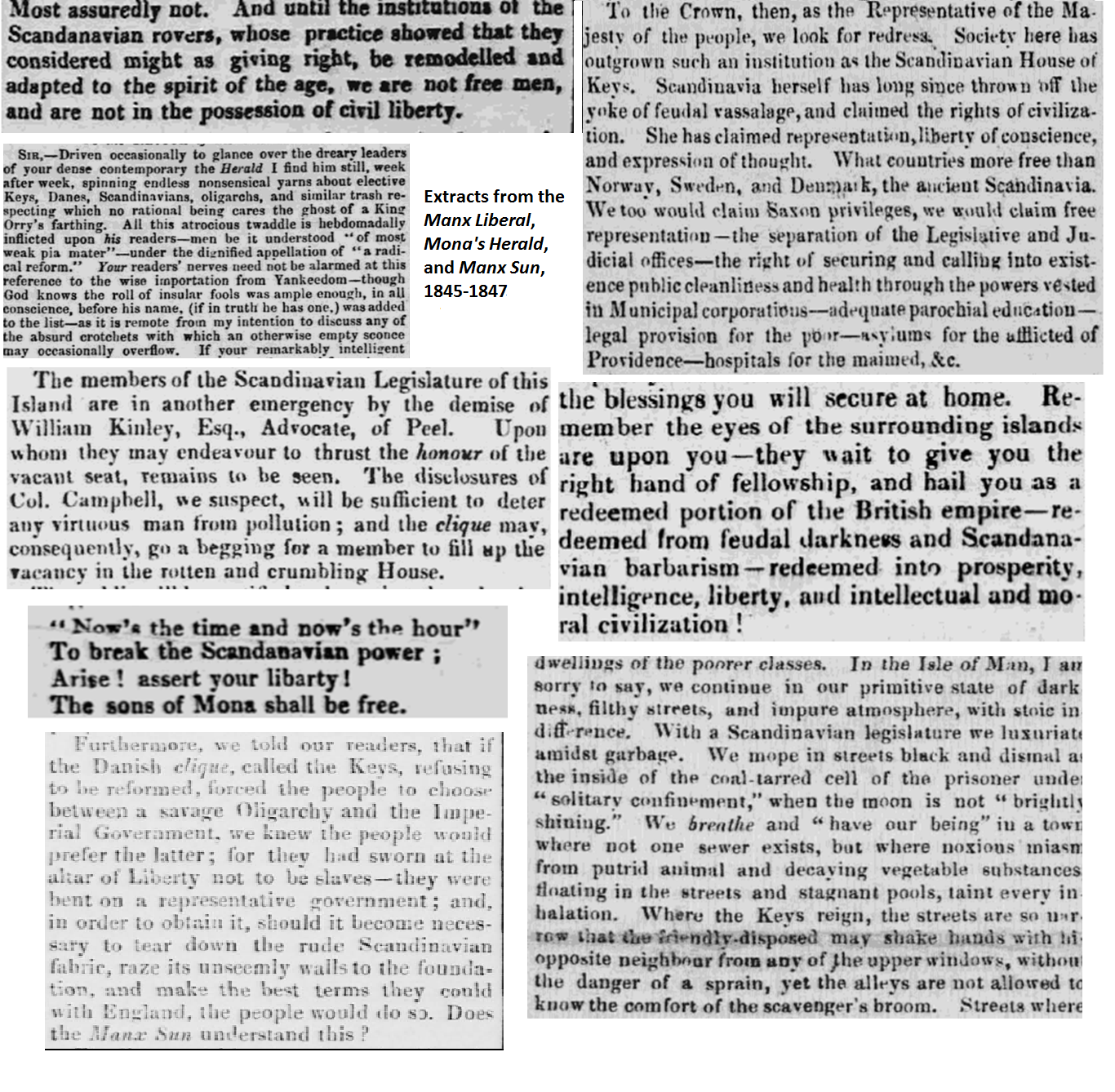
The Scandinavian Legislature: Rhetoric of the Reform Movement
Tynwald is thought to be the world’s oldest continuous parliament, with its origins in the period of Viking rule in the Island. The name Tynwald comes from the Norse word Thingvöllr, meaning assembly field or meeting place. This refers to the practice common to many ancient societies of meeting in the open air to discuss matters affecting the community and solve disputes. Some have described this as an early form of democracy, although it is unlikely to have involved the election of representatives.
The Viking origins of Tynwald were often invoked as an argument for reform of the House of Keys, but in two different ways. In the eighteenth and early nineteenth century, reformers would appeal to the Viking past as a golden age of democracy to which they hoped the House of Keys would be restored. By the mid-nineteenth century, however, the Viking origins of the Island’s parliament had become shorthand for the lack of progress. The parliament is frequently and derisively referred to by reformers as the antiquated ‘Scandinavian legislature’ which must be adapted to modern life.