The first elected House of Keys
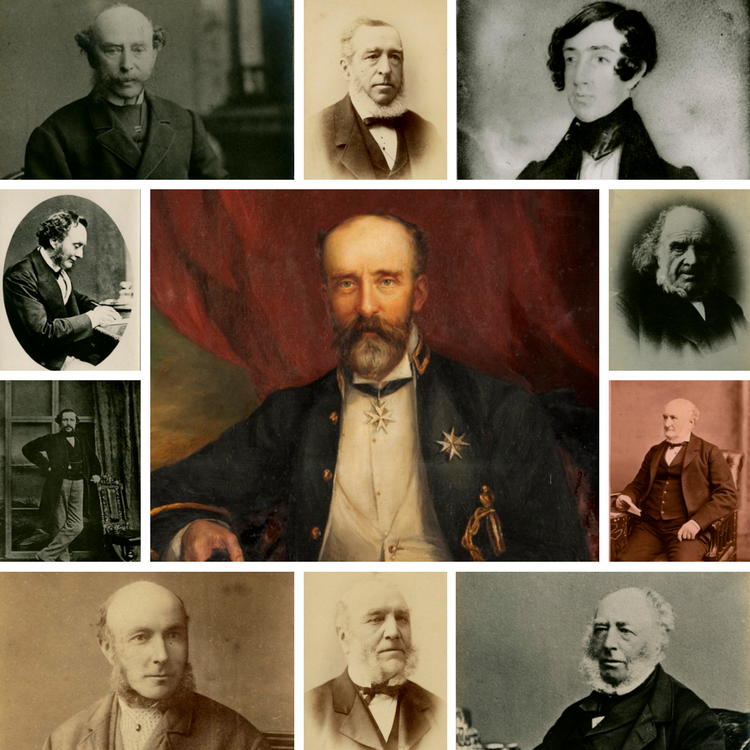
William Callister (1808-1872) was educated in Liverpool and Cheshire before returning to the Isle of Man to become a timber merchant with his father’s business. From 1837 he was committed to the reform movement and initially refused to accept his selection to the self-elected House of Keys on the grounds that it should be chosen by the people. In 1847 he finally accepted selection to the House of Keys, and in 1867 he was returned as one of the three Members for Ayre. In Tynwald, he was a member of the Harbour and Highway Boards. He was also a magistrate and Captain of the Parish for Bride, as well as founder of two banks. A.W. Moore described Callister as ‘not only one of the most eloquent speakers ever sat in the Manx Legislature, but one of the most valuable of Manx citizens’. He represented Ayre until his death in 1872.
Captain of the Parish of Andreas,
John Teare Martin was new to the House of Keys when he was elected in 1867 at an age when most people would be retiring from public life, as he said in his election speech. Following the election, he remarked that he was not a ‘talker’, but would endeavour to discharge his duties faithfully to the satisfaction of the electors. He remained in the House until 1874.
Edward C. Farrant (1830-1890) was selected as a Member of the House of Keys in 1852 when he was just 21 years old. One of the three self-elected Members who voted against the House of Keys Election Bill, Farrant nevertheless successfully stood for election in 1867. He was also Captain of the Parish for Lezayre at the time of his election. Farrant was often opposed to Governor Loch’s schemes, but he was said to be an eloquent speaker and was considered a valuable member of the House. On his death, the Speaker is reported to have said: ‘I am sure we shall all agree and join in saying that he set up for himself a very high code of morality in public and private life, and he ever acted up to it... . In every way, socially and generally, his loss will be deeply felt.’
John Moore Jeffcott (1817-1892) was educated at King William’s College and later studied law, being called to the Manx Bar in 1839. He developed a reputation as a sound lawyer and had the largest legal practice in the south of the Island. Jeffcott became a Member of the self-elected House of Keys in 1855 and was elected unopposed into the reformed house in 1867. He represented Castletown until 1882, when he retired due to ill health. Jeffcott was a member of both the Harbour and Highway Boards, and he held the position of High-Bailiff of Castletown from 1866 until his death.
William Fine Moore (1814-1895) left school aged 14 to join his father’s business of sail-cloth manufacturing, and he was later involved in many commercial ventures in the Island including the Isle of Man Steam Packet Company and the Isle of Man Banking Company. Upon entering the self-elected House of Keys in 1857, he dedicated himself to the cause of popular reform. He was successful in his effort to remove the 3s rate on houses in the town, and he introduced a progressive Highways Bill. He topped with poll in the Douglas election with 471 votes, the highest mandate of any MHK in the Island. He represented Douglas until his retirement from ill health in 1875.
George W. Dumbell (1804-1887) was elected as the second member for Douglas with 464 votes. Dumbell had been a member of the self-elected House of Keys from 1840 to 1857. A former lawyer, at the time of his election he was a banker, landowner and mine-owner. A leading Conservative voice of the period, he was a staunch opponent of the reformer and founder of the Mona’s Herald Robert Fargher. Dumbell sued Fargher on three occasions, famously resulting in the editor’s imprisonment. Dumbell remained in the Keys until 1880.
John Senhouse Goldie-Taubman (1838-1898) was elected as the third member for Douglas with 457 votes. He had been a Member of the self-elected House of Keys since 1859. Goldie-Taubman served as the first Speaker of the democratically elected House of Keys. In doing so, he followed in the footsteps of his father, grandfather, and great grandfather, who had all served as Speakers. Goldie-Taubman was a respected Speaker, and ‘his decisions on points of order and procedure were never disputed’. He served as Chairman of the Asylums Board, as a magistrate, and also had a major role in the success of the Isle of Man Railway Company. In 1886, he became the first Right Worshipful Grand Master of the Manx Provincial Grand Lodge of Freemasons, and in 1897 he was knighted. He held the position of Speaker until his death in 1898.
A new Member of the House of Keys,
Richard Rowe (1823-1886) topped the polls in Garff with 143 votes. Rowe was Captain of the Laxey Mines. When George W. Dumbell became chairman of the Laxey Mining Company he built a house for Rowe which is now the Mines Tavern. Rowe was heavily criticised in the Isle of Man Times in 1874, when the writer argued that his election was due to his role as Captain and Manager of the Laxey Mines, and also said that Rowe had never made a speech of worthy note in the House of Keys. Rowe remained in the Keys until his death in 1886.
William Haslam polled second in Garff with 98 votes. He had joined the self-elected House of Keys in 1858, and remained in the popularly elected House until 1871, when he resigned due to ill health.
John Edward Christian polled in third with 75 votes, the lowest number of any successful candidate. A new Member of the House of Keys, he died in December 1867, prompting the first by-election.
William Edward Stevenson Moore topped the polls in Glenfaba with 149 votes, beating his father by 8 votes. An advocate, he had been called to the Bar in 1862. Unfortunately, his ill health prevented him from taking full part in debate, and he died in 1870 at the age of 36.
John Stevenson Moore (1804-1895), a Methodist and teetotaller, came second in the polls to his son with 141 votes. He had not been formally involved in the reform movement, but is reported to have been involved in the political instruction of Manx country people. In his election speech, John Stevenson Moore lauded the changes to voting on the Island and thanked the Lieutenant Governor for the changes that had taken place. He remained in the Keys until 1874.
John Gell, Captain of the Parish of German, had been selected to join the House of Keys in 1854. He came third in the polls, and remained in the Keys until 1868.
Thomas Craine, Captain of the Parish for Ballaugh, was a new member for Michael in 1867. In his election speech, he said it would be the proudest day of his life when he took his seat in the House of Keys, and he promised to leave his seat if two-thirds of the electorate called for his resignation. He remained in the House of Keys until 1878.
John Frissell Crellin (1816-1887) was born in Castletown and educated at King William’s College, before going on to study medicine in London. Crellin was appointed as a Member of the self-elected House of Keys in 1843 and acted for many years as Deputy Speaker. An antiquarian, he reported on the antiquities of the Island as part of a Tynwald Commission, and collected Manx literature and coins. His ill health prevented him from accepting the position of Speaker and was also the reason behind his retirement from the House in 1874.
Evan Gell (c. 1807-1887) had been an MHK since 1844. Aside from serving as an MHK, Gell was a Justice of the Peace and a Captain of the Parish of Michael. He had been a farmer and as an MHK he went to considerable lengths to improve the breeds of cattle and horses on the Island, for which he was awarded the presidency of the Agricultural Society. Gell was also a valued member of the Highway Board.
William Dalrymple (1815-1890) came top of the polls in Middle with 216 votes. Born in Scotland, Dalrymple had lived in Union Mills for most of his life and was described as ‘kind and courteous to all, faithful in the discharge of duty, he was a true man and a sincere Christian’. He initially studied for the Ministry, but abandoned this to take up medicine; several other professions followed before Dalrymple settled on woollen manufacturing in Union Mills. Supported by the radical Richard Sherwood at the hustings, Dalrymple’s election speech was described as ‘a gem’. He went on to play a significant role at the first sitting of the democratically elected House of Keys on 18th April when he became immersed in a two and a half hour debate with George W. Dumbell over who the new Speaker should be, with Dalrymple favouring Goldie-Taubman as opposed to Dumbell’s nomination of John F. Crellin. He remained in the Keys until his death in 1890.
John Caesar Tobin Harrison polled second with 199 votes. He had been selected as a member of the House of Keys in 1865. An advocate who had trained with Dumbell, at the hustings he was accused of being ‘just like a weathercock’ by Mr P.H. Leece, who later retracted his comments. He remained in the House of Keys until his death in 1869.
Captain of the Parish of Onchan,
Captain Mark Goldie polled in third place with 148 votes. He had been a member of the self-elected Keys since 1851, and he served until his resignation in 1872. For his services, Goldie was duly honoured in the pages of the Isle of Man Times: ‘His political antipathies were strong, his prejudices were deep, but they had one merit – they were honest; and upon his complete independence not a shadow of doubt could be cast’.
Robert John Moore (1816-1884) was elected unopposed as the Member for Peel. He had been an MHK since 1850, and Secretary of the House since 1858. Moore was a lawyer who became High Bailiff of Peel in 1853. An antiquarian, he took a great interest in the preservation of Peel Castle and Cathedral. In his victory speech he proclaimed the election to be a red letter day in his history and in the history of Peel, and he said that he would resign if he ever found that he could not represent the interests of the majority of the electors in Peel. A.W. Moore described him as a man who was greatly esteemed and respected by all classes. He represented Peel until 1880.
The Revd William Bell Christian (1815-1886) was elected unopposed and with enthusiasm by the people of Ramsey. The son of Deemster John Christian and a member of a long-established Manx family, he inherited the estate of Miltown in 1852. He was described as a man with a vast amount of intelligence and someone who was ‘acquainted with what transpires around him’. Christian was a radical Liberal in his views. On his election, he declared that he was 'a reformer, not a Conservative’, and he demanded higher taxation, compulsory education, poor rates, and extension of the franchise when appropriate. He represented Ramsey until 1883, when he was made Receiver-General.
Captain of the Parish for Arbory,
Henry Watterson came top of the polls in Rushen with 222 votes. He retired in 1874, but stood again for election in 1880 and served until 1891.
A new MHK,
William Woods of Balladoole polled second in Rushen with 152 votes. Later that year he was a member of the Commission appointed to inquire into moving the Courts from Castletown to Douglas. He was a member of the Keys until 1891.
Thomas Moore of Billown, who had been selected to join the Keys in 1864, polled in third place with 114 votes. Captain of the Parish for Malew and Justice of the Peace, he remained in the Keys until 1874.