The first general election of the House of Keys, 1867
Written by Dr Kit Gawne
Introduction
Whilst Britain had already extended the vote to all men owning property worth £10 or more in 1832, the House of Keys continued to be a self-elected body which sat in government behind closed doors. When a vacancy occurred, which only happened upon death, resignation or promotion to a position in the Legislative Council, the Keys nominated two persons to the Lieutenant Governor for his decision as to which one should then be appointed.
Robert Fargher, editor of the reforming Mona’s Herald
Whilst protest petitions were raised in the late 1700s and John Murray, the fourth Duke of Atholl and Lord of Man, derisively referred to the Keys as being ‘no more representative of the people of Man than of the people of Peru’ in 1822, the call for political reform started in earnest in 1833 when Robert Fargher launched the liberal and dissenting newspaper, the Mona’s Herald, which became involved in a persistent and vigorous campaign to bring about a democratically elected House of Keys. Through the Mona’s Herald the political reformers now had a vehicle to express their concerns. From that moment may be dated the beginnings of Manx political reform. Fargher persistently and vigorously campaigned for the meetings of the House of Keys in their building in Castletown to be open to the press and public, and that its members should be chosen by the vote of the people. His inflammatory ‘letters to the editor’ resulted in an acrimonious libel action in 1844 which resulted in Fargher being gaoled in Castle Rushen. Supporters paid the fine, and the Mona’s Herald reported that on a triumphal procession back to Douglas ‘Flags were displayed on public houses, shawls and handkerchiefs were hung out at the farm houses, and, in the absence of these, at thatched cottages patriotic old matrons hung out their wearing garments’.
Reform petitions
In 1845 a delegation of representatives of the people presented a petition demanding political reform to an unenthusiastic Lieutenant Governor John Ready for forwarding to the Home Secretary. Unsurprisingly, the members of the Keys (known as the ‘Castletown clique’, the disparaging contemporary term used to describe them) did not support the call for their own reform. The Home Office urged Ready’s successor, Lieutenant Governor Charles Hope, not to lose sight of the point that if the House of Keys was ever to become a democratically elected body then it would scarcely be inclined to continue to comply with the current arrangement by which the Manx surplus customs revenue was merged into the general funds of Britain, with little of it returning to benefit the Isle of Man. When further petitions were sent to Sir George Grey, the Home Secretary, he threatened that the situation could be addressed by the Isle of Man being incorporated into Britain.
‘If the House of Keys had been a representative body, elected by the people’
In 1853 a combined deputation of the Keys and the people was in talks with James Wilson, the Financial Secretary to the Treasury, on Tynwald having some control of the surplus customs revenue. Wilson issued a document which stated that ‘if the House of Keys had been a representative body, elected by the people of the Island, the Lords of the Treasury would have been disposed to have taken a much more favourable view of your proposal to entrust to it the administration of these funds’. Although the House of Keys was unprepared for this unexpected offer, the attitude of some members was changing. They were slowly coming round to the idea that financial and constitutional reforms were inextricably linked. However, there was delay which was undoubtedly the result of Lieutenant Governor Hope’s cautious resistance to change, the reluctance of the majority of the Keys to become less self-interested and Britain’s continuing imperial subjugation of the Isle of Man.
Lieutenant Governor Henry Loch
Henry Brougham Loch, aged only thirty-five and just recently married, was appointed Lieutenant Governor of the Isle of Man in February 1863. Loch had previously been in the army and had been involved in a diplomatic and military mission in China when he and the British Commissioner rode behind the Chinese lines under a flag of truce, but they were taken prisoner and tortured. They were able to escape their captors just before the arrival of a death warrant signed by the Emperor ordering their beheading. Just a month after his appointment in the Isle of Man, Loch received a request from John James Moore (a veteran Manx reformer who was acting as an agent for the inhabitants of the Isle of Man) to forward to Queen Victoria a petition complaining about the constitution of the House of Keys and claiming that Tynwald was enacting laws without the consent but at the expense of the people. People in the Island had been seeking greater financial autonomy and constitutional amendment for some time, and the need for improvements convinced Loch that he must speedily, determinedly and single-mindedly bring about resolutions. He realised that there should no longer be taxation without democratic representation.
James Brown, editor of the reforming Isle of Man Times
Calls for reforms were again being raised from a familiar quarter, that of yet another forceful owner and editor of a Manx newspaper: James Brown of the liberal Isle of Man Times. Early in 1864 the recently created Douglas Town Commissioners wanted to extend and consolidate their powers. Amongst the many pejorative remarks made about this in the House of Keys was one from a member to the effect that the most they could be given was control over the donkeys on the shore. In reporting the proceedings of the House of Keys, the Isle of Man Times declared that ‘this elicited marks of approval of the don-keys around him’. This and similar criticisms resulted in Brown being summoned to attend the House of Keys where he was told that the members had already resolved that he was guilty of contempt and breach of privilege and sentenced him to be imprisoned in Castle Rushen for six months. He successfully appealed against his sentence to Lord Chief Justice Cockburn and three other judges sitting in London and then filed an action against all the members of the Keys who had signed the warrant which had led to his imprisonment. The resultant trial awarded Brown damages and costs.
Loch’s negotiations
The gravity of the urgent need to have sufficient public money to complete the building of a new breakwater, the continued calls for a directly elected House of Keys and the involvement of the Keys in the acrimonious incident with James Brown helped to convince Henry Loch that the situation required urgent action. In March 1866 he was able to go to Tynwald to disclose the results of his year-long confidential negotiations with the British authorities. If Tynwald agreed to an increase in the amount of customs duties payable on certain imported articles, then the additional revenue that was created would be used towards the improvement of the harbours and other public works. A condition, one resulting from Loch’s own initiative, of the acceptance of the above fiscal changes was to be that the representatives in the House of Keys should in future be elected by the people. After a long deliberation, the members eventually agreed to endorse both proposals, and they passed a Bill which allowed for the Island’s first general election to take place in April 1867.
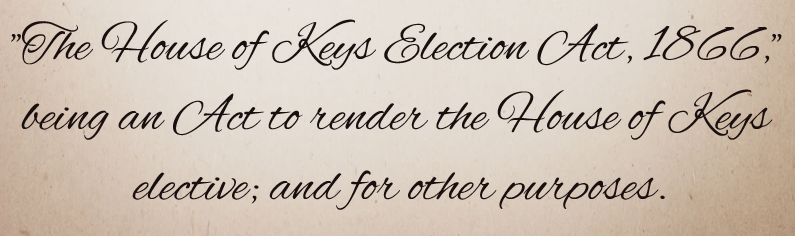
The ‘House of Keys Election Act, 1866’
Loch sent the ‘House of Keys Election Act, 1866’ to the Home Office for Royal Assent, and it was promulgated by Tynwald Court in December. The Act allowed for the towns of Peel, Ramsey and Castletown to have one member each, the town of Douglas and the sheadings of Ayre, Michael, Garff, Glenfaba, Middle and Rushen to have three each. Those entitled to be Members of the House of Keys were males aged at least twenty-one who were owners of real estate of the value of £100 and over or who were owners of real estate of the annual value of £50 and had a yearly personal income of £100 and over. The qualifications for voters were that they must be males aged at least twenty-one who were owners of real estate with an annual value of not less than £8. Tenants had to occupy land or tenements with an annual rent of not less than £12. Women (widows and spinsters who owned property of a set value) would have to wait until 1881 to gain suffrage when the Isle of Man became the first country to give women the right to vote. On 19 March 1867 Lieutenant Governor Henry Loch signed a proclamation at Government House at Bemahague for the dissolution of the self-elected House of Keys’.
On the hustings
Early in 1867 the election campaign began to gather momentum, and meetings were arranged for prospective candidates to declare their policies. One meeting which took place at the assembly room in Douglas saw scarcely a dozen members of the public in attendance at its outset, although before it closed there were close on sixty. But another meeting at the Victoria Hotel saw 800 to 1,000 people come to hear the views of the candidates. Thomas Fargher addressed a meeting at Maughold with a long, noisy and declamatory harangue which resulted in such a general clamour that the chairman had to adjourn the meeting. An uncertain John Edward Christian issued two manifestos, one for the constituency of Ramsey and another for the constituency of Garff. John Caesar Tobin Harrison, a candidate for the rural constituency of Middle, had his nomination objected to as he was a lawyer who was employed by Douglas Town Commissioners, and he was accused of being ‘the person who treats the electors in the public-house to rum, or gin, or whiskey, or anything they will drink, if they will only vote for him’.
Nomination day
The nomination and election days were due to take place all over the Island during the period from 2 to 5 April. In Douglas there were four nominees for just three seats. William Fine Moore and John Senhouse Goldie-Taubman, the sitting members, together with George William Dumbell were the establishment’s choice and offered themselves en-bloc. But the lawyer Richard Sherwood came forward as a surprise liberal opponent. On nomination day, 2 April, people gathered early outside the court house in Athol Street. The first candidate to arrive was Sherwood whose supporters sported blue rosettes. Next to arrive was Major Goldie-Taubman, followed by Dumbell and Moore who both came by carriage. Moore’s supporters included ladies dressed in red outfits and gentlemen on horses decorated with red ribbons, and Moore himself wore a scarlet camellia in his buttonhole. Similar scenes were held all over the Island, even in uncontested constituencies. In Ramsey the principal shops were closed on nomination day, and a great number of people assembled outside the court house which was decorated with flags, bunting and an arch of evergreens surmounted by a flag bearing the legend ‘Representation and Progress’. The crowd then marched to the beat of a band to Milntown, the residence of the unopposed candidate, the Reverend William Bell Christian, where he was asked to step into a carriage drawn by four light-coloured horses, and the whole procession returned to Ramsey for speeches, celebrations and parades.
The first public election
Polling day in Douglas was on Wednesday 3 April, and glorious sunshine ensured that the flags and banners hanging outside the houses and shops were displayed to their best. Voting took place from eight o’clock in the morning. Carriages decked out in blue or red ribbons and covered in placards conveyed the voters to the two polling stations, one at the court house in Athol Street and the other at St Matthew’s church in Market Place. The atmosphere was made more electric by the progress of the vote being announced every hour to the excited crowd. One of the red supporters got so carried away that he seized a blue flag and broke its staff. A drunken carriage driver drove into the crowd, but his horse was forced back by a dozen sturdy men, causing the driver to fall out of his seat. Accusations of intimidation and partiality were made because votes were not made in secret but were openly recorded in poll books by tellers, some of whom were members of Dumbell’s banking staff. The result was declared from the court house at four o’clock that afternoon. Moore received 471 votes, Dumbell 464, Goldie-Taubman 457 and Sherwood 317. The three successful candidates were paraded around the town in carriages pulled by their supporters before they all adjourned to their committee room at the British Hotel on the North Quay. A barrel of ale was gratuitously distributed to all-comers, photographs were taken and church bells were rung.
The first public election of the House of Keys saw thirteen of the previous twenty-four members elected. The eleven new members were mainly of a similar political persuasion as the previous members. John Senhouse Goldie-Taubman was chosen to serve as the first Speaker of the first publicly elected House of Keys.
The future
Although the election processes had been novel and exciting, the reality was that only a small minority of the population had the right to vote, an even smaller number had the property qualification to stand for the Keys. The conservative character of the new House had hardly altered from that of the old, and the Lieutenant Governor, generally backed by his Legislative Council, continued to be the authority from whom all executive decisions emanated. Despite the disappointments, Henry Loch’s important reforms were very significant and ensured the implementation of the most important elements of the Isle of Man’s democratic needs: properly elected political representation to act in the interests of the Manx people and a significant advancement in Tynwald’s control of public finances. The reforms, although by no means fully complete, were major steps towards more competent and mature selfgovernment, with the House of Keys now being answerable to the people and having increased financial responsibilities. Political democracy in the Isle of Man had at last become a reality.